Christmas, Christ, and Krishna
Two of the world’s greatest teachers, Jesus Christ of Nazareth and Krishna of Northern India, come from different times and different places, yet share the same poignant and profound mission: the salvation of humanity. They brought with them messages of love and peace, and provided a human form and living example from which we could learn.
JESUS CHRIST
Every year we celebrate Christmas as a glorious and sacred day – filled with love. But the very first Christmas, though it brought light to the world, was actually surrounded with darkness. And the Christmas story is filled with symbolism and messages for living a good life.
The world at that time was a dark place. Some of the writers of the day described it as filled with gloom, anguish, and contempt. Malachi, the last book in the Old Testament, was written four centuries prior to the birth of Jesus Christ. Rome was in power, and the people of Israel were oppressed. Herod, a descendent of Edom, ruled in the Davidic city of Jerusalem, and soldiers walked the streets. The citizens felt like exiles in their own country. The nation of Israel was fractured as four opposing groups fought for leadership. This led to constant friction, and many riots.
The Virgin Mary, just 15 or 16 years old, was engaged to a much-older Joseph in an arranged marriage. Joseph was a highly skilled carpenter, but he was also poor, which is probably why he had not married earlier and had no children of his own. When they discovered that Mary was pregnant, Joseph planned to “divorce” her quietly. But one night Joseph had a dream in which an angel came to him and said, “Do not fear to take Mary as your wife, for that which is conceived in her is of the Holy Spirit: she will bear a son, and you shall call his name Jesus, for he will save his people from their sins.” Mary also had a vision, the angel Gabriel came to her and said she was “highly favored,” and that “the holy one to be born will be called the Son of God.”
Adding more stress into the mix, Caesar Augustus decreed that a census, the first of its kind, be taken so that the Roman government could be sure that everyone paid their taxes. In Palestine, families were required to register in their tribal town, rather than where they lived. Joseph’s family was from the lineage of David, which meant that he and Mary had to travel from Nazareth to Bethlehem, a journey of about 100 miles. It was an arduous task on foot, and it took them three days to reach their destination. By the time they got to Bethlehem, Mary was ready to give birth. Since it was a mandatory census, many travelers were in town. There were no hotels back then, people generally stayed with family or friends in one of their guest rooms. When the bible says there was “no room at the inn” it likely means that there was no guest room available for the couple.
The homes in Bethlehem were mostly built to have two levels. The upper level was where the family slept, and the lower level was like a stable where the animals slept, and the family lived during the day. The warmth of the animals kept the upper level heated at night. Joseph and Mary, having no money to pay for a room, and no other place to stay, were probably offered this area of someone’s home. It was there, amongst the animals and the hay, that Mary gave birth. The stable is representative of the earth plane, and here they were very connected with Mother Earth. There were no walls, no people – it was quiet, still and pure. This represents how we are connected with the Divine through silence, and through nature.
Since there was no crib, the baby was placed in a manger, a food trough for animals. The manger represents humbleness and simplicity, that we don’t need anything fancy. Baby Jesus was wrapped in swaddling clothes, limiting mobility, which is used to soothe a baby. This represents the confinement and limitations that are imposed on us by a physical body.
A bright star appeared in the sky when Jesus was born. Wise men from the east, also called Magi (coming from the Greek word “magos,” or magic), educated in the sciences of astronomy and astrology, could follow the patterns of the stars. They knew this star was new and special, representing a great change in the Universe. They were guided to follow the star that would lead them to the king of kings. They first arrived in Jerusalem, and asked around: “Where is the one who has been born king of the Jews? We saw his star in the east and have come to worship him.” King Herod caught wind of this and felt that his power was threatened. He called for his top advisors, who explained that it was foreseen that this child born in Bethlehem would be a leader of the people, a king. King Herod then secretly contacted the Magi and sent them to Bethlehem saying: “As soon as you find him, report to me, so that I too may go and worship him.”
The three wise men followed the star and found Mary and baby Jesus in the stable. The baby Jesus glowed from the light within him. They could feel the divine energy. They bowed down to Jesus and offered precious gifts. Gold, associated with Kings, was given in recognition of Jesus as the King of Kings. Gold is also symbolic of love, as in gold wedding bands, and showed an offering of spiritual love for him. Frankincense, used in worship rituals in churches, showed that others would worship Jesus and learn from his teachings. Myrrh, a resin used in sacred oils, perfumes and medicines, was given to symbolize a willingness to actively serve Jesus Christ by living according to the truth that he teaches.
The three magi were warned through a dream that King Herod had a horrible plan, so they decided to not tell Herod of the baby’s location. Instead they left for their homes in another direction so that Herod would be thrown off. When Herod learned that the men did not comply with his scheme, he ordered the execution of all the male children in and around Bethlehem.
It was tradition in those times to name a son after his father. Naming the baby Jesus, rather than Joseph, broke with tradition, and symbolized a new beginning. Both Joseph and Mary knew that it was their role to protect this child, he needed time to grow up so he could fulfill his destiny. They left for Egypt so that Jesus could grow up out of the public eye and away from the wrath of King Herod. When Herod died in 4 AD the family returned to Nazareth.
KRISHNA
Flash back to more than 3000 years earlier, before the birth of Jesus Christ. This is when Lord Krishna was born in northern India. Krishna is known as the eighth avatar, or incarnation, of Lord Vishnu.
The situation at that time in India was dire. Mother Earth was unable to bear the sins and cruelty of the many evil rulers and kings. She prayed to the creator of the Universe, Brahma, to help unburden her of this problem. Lord Brahma then prayed to the supreme Lord Vishnu to reincarnate and free Mother Earth from the evil rulers.
One of the evil kings was Kansa, ruler of Mathura. His sister, Devaki, was married to Vasudeva. On Devaki and Vasudeva’s wedding day a voice from above stated that Devaki’s eighth son would bring an end to Kansa’s rule and Kansa would be killed. Kansa, shaken by this, held the couple hostage, and then killed all seven of the children they gave birth to. Devaki and Vasudeva were afraid to have another child and made no effort to conceive.
One night, Lord Vishnu came to them, and said that he would appear as their son, and rescue them from Kansa. Devaki miraculously became pregnant. The day the divine baby Krishna was born, Vasudeva was magically freed from his prison. As he ran away with the infant, Lord Vishnu removed all the obstacles from Vasudeva’s path.
Vasudeva came to a home in Gokul, where he exchanged baby Lord Krishna with the newborn girl of another couple. He then returned to prison with the baby girl. When Kansa found out about this child, he tried to kill her, but she ascended to the heavens and transformed into the goddess Yogamaya. Yogamaya said: “O foolish Kansa! What will you get by killing me? Your nemesis is already born.”
Krishna was raised by his foster parents as a cowherd in Gokul and he learned to play the flute. When he returned to Mathura, he killed Kansa and restored his father Vasudeva to power.
THE PARALLELS
As you can see, there are many parallels in these two stories.
-Both Krishna and Jesus were born in difficult times. They came to take us from darkness to light, to awaken us.
-Both were born in non-traditional environments, Krishna in a jail cell, Jesus in a stable.
-Both were threatened by evil kings.
-Both fled their homes to be safe while growing up.
-Both provided a form for us to love and worship. It is difficult to imagine or worship the Absolute, but we recognize and have experience with form. We can worship the Divine in man.
-Both sets of parents had dreams or visions.
Their names are similar. Christ comes from the Greek word “Christos” meaning “the anointed one.” Krishna in Greek is the same as Christos. In Bengali Krishna is “Kristo” which is the same as the Spanish word for Christ, “Cristo.” Swami Prabhupada says: “Whether you call God Christ, Krsta or Krishna, ultimately you are addressing the same Supreme Personality of Godhead.”
In addition, as they grew up, they both attracted students. Krishna in the fields with the gopis and cows, and Jesus in the Temples. When Jesus was 12, Mary and Joseph thought he was lost until they eventually they found him in a Temple, amidst elders and pundits discussing scripture. Jesus looked unfazed – he asked his parents: “Why look for me? Don’t you know I must be about my father’s business?”
They both had an awareness about their divinity, and their followers recognized them as divine.
Krishna: “Think of Me.”
Jesus: “Follow Me.”
Krishna: “I am the light of the world – the light of all lights.”
Jesus: “I am the light over all things. I am the light of consciousness through which all things shine. You are the light of the world. Let your light shine before others.”
They provided a refuge:
Krishna: “I am the way, come to Me.”
Jesus: “I am the way and the truth and the life. No one comes to the Father except through me. If you really knew me, you would know my Father as well…”
Both were known as both sons of God and God incarnate:
Krishna: “I am birthless, I am deathless, Beyond this time and space. When goodness grows weak on earth, Then I am needed in this place. I come to deliver the holy, to re-establish what is right. Those who understand my role here Are guided to the light.”
Jesus: “If God were your Father, ye would love me; for I proceeded forth and came from God; neither came I of Myself but He sent me.”
Both advised in their teachings to work for the welfare of the state:
Krishna: “That man attains peace who lives devoid of longing, free from all desires and without the feeling of “I” and “mine.”
Jesus: “Him that overcometh “I” will make a pillar in the temple of my God and he shall go no more out.”
Both were called saviors, and were the second person of the Trinity.
Krishna: “Brahma, Vishnu, Siva (Creator, Sustainer, Destroyer.)”
Jesus: “Father, Son, Holy Ghost”
Both emphasized the message of love and peace in their teachings.
Krishna: “Be friendly to all living beings. Show compassion to everyone. Be free from delusions of “I” and “mine.” Accept pleasure and pain as if one.”
Jesus: “A new commandment I give unto you, That ye love one another; as I have loved you, that ye also love one another.”
Krishna’s birthday, Janmashtami, is celebrated with great devotion and enthusiasm in India.
Jesus’ birthday is celebrated worldwide as Christmas.
——-
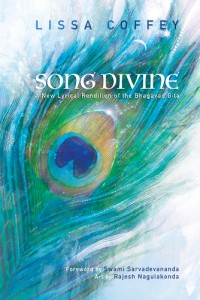
My new book is Song Divine: A New Lyrical Rendition of the Bhagavad Gita
Download